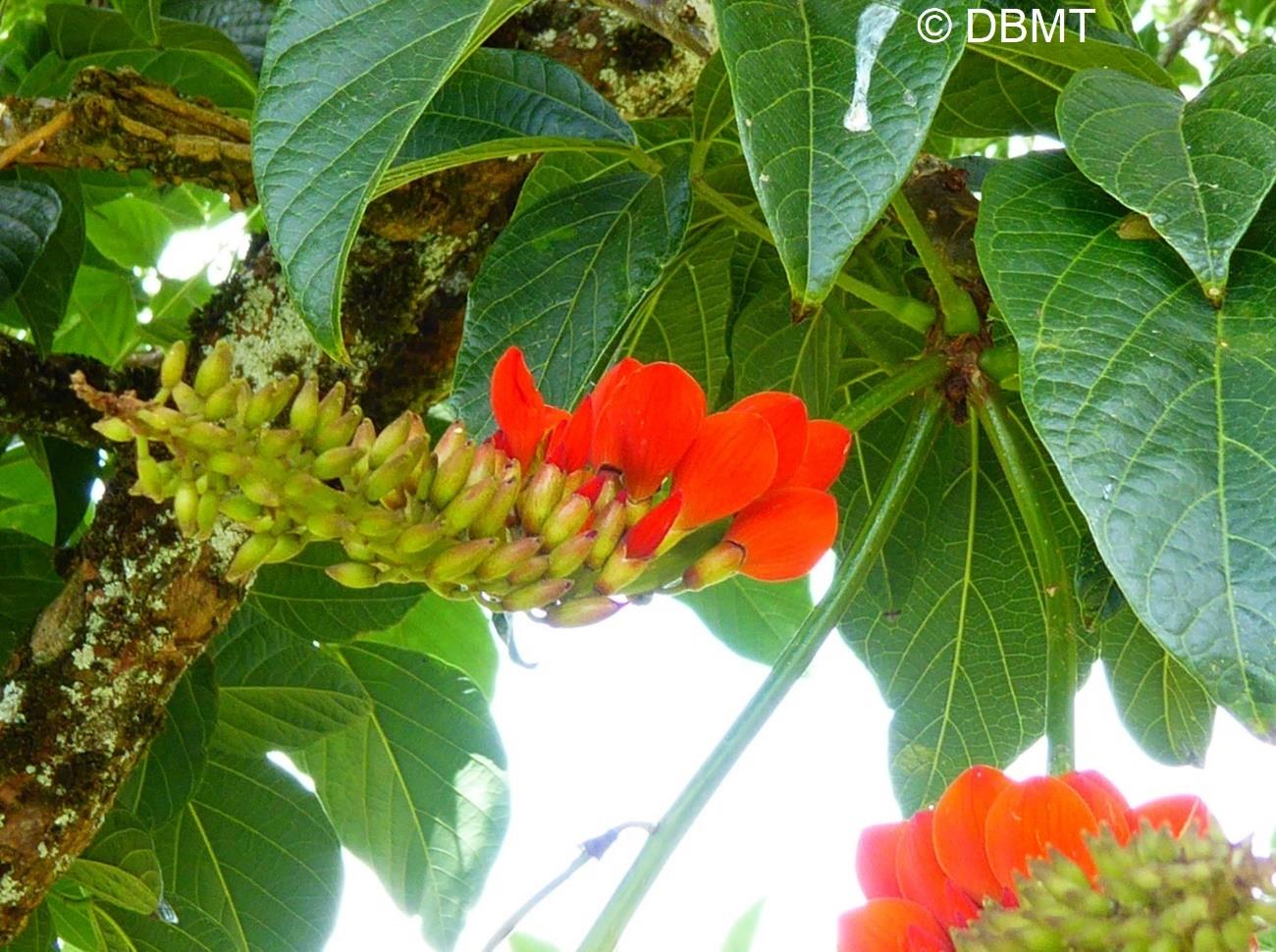
*Pajuro (pisonay)

Erythrina edulis

Jardines: Shalcapata, Lili and Rodolfo
Traditional uses in Leymebamba: It is prepared in a slightly sweet jam (source: Don Jabier Farje)
Description: Although Erythrina edulis is well-known in Andean communities, its potential remains underutilized. Promoting its study and promotion could help strengthen both food security and environmental conservation in the Amazon region and beyond.
Properties and uses:
1. Nutritional:
The seeds of Erythrina edulis are an excellent source of protein (around 18-25%), carbohydrates, and fiber.
They contain essential minerals such as calcium, iron, and phosphorus, as well as B vitamins.
The seeds can be eaten cooked, toasted, or ground into flour to prepare breads, soups, and other foods.
In some communities, the pulp of the pods, which has a sweet flavor, is also used.
2. Medicinal
Digestive system regulator: Due to its fiber content, it promotes intestinal transit and helps prevent constipation.
Anemia control: Its iron content makes it a suitable food for treating nutritional deficiencies.
Energy-boosting and strengthening properties: It is considered an ideal food for people in recovery or with high energy demands due to its macronutrient content.
3. Agroforestry and ecological benefits
Nitrogen fixer: Erythrina edulis is a leguminous plant that improves soil fertility by fixing atmospheric nitrogen. This makes it an ideal component for agroforestry systems.
Erosion control: Its root system helps stabilize soils, especially on steep slopes.
Wildlife habitat: Its flowers are an important source of nectar for bees and other pollinators.
4. Cultural and traditional benefits
Fodder: The leaves and pods are used as animal feed (cattle, pigs, and poultry) due to their high protein content.
Wood: Although not its primary use, the tree's wood can be used to make tools and as firewood.
Importance in the Amazon region: In the Amazon and other regions of Peru, Erythrina edulis plays a key role in the food security of rural communities. Its cultivation is especially valuable for farming families due to its low maintenance costs and multiple benefits.
Economic and sustainable potential
Marketing: Although its use is more common locally, chachafruto has the potential to be integrated into national and international markets as a superfood rich in protein and nutrients.
Sustainability: Its cultivation can contribute to reforestation, soil improvement, and the diversification of agricultural systems.
Referencias:
Brack Egg, A. (1999). Diccionario Enciclopédico de Plantas Útiles del Perú. Centro de Estudios Regionales Andinos "Batolomé de las Casas". Lima, Perú. 556 p.
Cárdenas-Villanueva, L. A., Ramos-Zuñiga, R., Huamán-Gamarra, J. L., & Ramirez Mena, E. (2021). Effect of the inclusion of pisonay meal (Erythrina edulis) of three regrowth ages on the productive characteristics in guinea pigs (Cavia porcellus).
Gerardo, P. (1984). Isolation and characterization of a lectin from the seeds of Erythrina edulis. Phytochemistry, 23(6), 1229-1232.
Intiquilla, A., Jiménez-Aliaga, K., Zavaleta, A. I., Arnao, I., Peña, C., Chavez-Hidalgo, E. L., & Hernández-Ledesma, B. (2016). Erythrina edulis (pajuro) seed protein: A new source of antioxidant peptides. Natural product communications, 11(6), 1934578X1601100620.
Intiquilla, A., Jiménez‐Aliaga, K., Guzmán, F., Alvarez, C. A., Zavaleta, A. I., Izaguirre, V., & Hernández‐Ledesma, B. (2019). Novel antioxidant peptides obtained by alcalase hydrolysis of Erythrina edulis (pajuro) protein. Journal of the Science of Food and Agriculture, 99(5), 2420-2427.
Parraga, A., Gonzales, J. A. V. I. E. R., Portales, R. O. S. A. R. I. O., Ruiz, C. A. N. D. Y., & Rojas, R. (2021). Proximate analysis and aminoacid profiles of leaves, flowers, pods, and seeds of erythrina edulis from Peru. Int. J. Pharm. Pharmaceut. Sci, 13, 30-2.
Russo, R. O. (1991). Erythrina (Leguminosae: Papilionoideae) a versatile genus for agroforestry systems in the tropics. Journal of Sustainable Agriculture, 1(2), 89-109.
Soukup, J. (1978). Vocabulario de los nombres vulgares de la flora peruana y catálogo de los géneros. Editorial Salesiana. Lima, Perú. 435 p.